
Unicode: The System You Never Notice But Use Every Day
Unicode is something you rarely notice, but it quietly makes sure everything you type or read online appears correctly. The problem is that without a universal system, text can break, showing strange symbols or question marks instead of real words. This becomes frustrating when messages, websites, or content stop making sense across different devices.
Unicode solves this by assigning a unique code to every character in every language, ensuring consistency everywhere. The best part is that it’s easy and automatic, supports attractive and expressive content like emojis and multiple scripts, is used globally by billions of people, and works instantly whenever you communicate, making the internet smooth, readable, and truly connected.

Quick Summary
- Unicode is a universal encoding standard that gives every character in every language its own unique code — it’s what lets Bangla text work on any phone, browser, or website.
- Bijoy is an older, ANSI-based encoding built for Bangla print publishing; it only displays correctly when specific fonts are installed.
- The two systems are incompatible, which is why Bangla text often turns into unreadable symbols when moved between them.
- This guide explains how Unicode works, why it won on the web, and how a free converter bridges the gap between the two.
So what actually is Unicode?
At its simplest, Unicode is just a shared agreement. It says: every letter, symbol, or character in every language should have a unique number. That’s it. Nothing fancy.
Before this idea existed, computers were kind of chaotic with text. One system wouldn’t understand another. If you opened a file in the wrong encoding, it would just break — random symbols, question marks, or complete garbage text.
Unicode fixed that mess.
Now every character has a fixed identity. For example:
- A = U+0041
- ব = U+09AC
No matter where you are or what device you’re using, that doesn’t change. And because of that, text today just works everywhere.
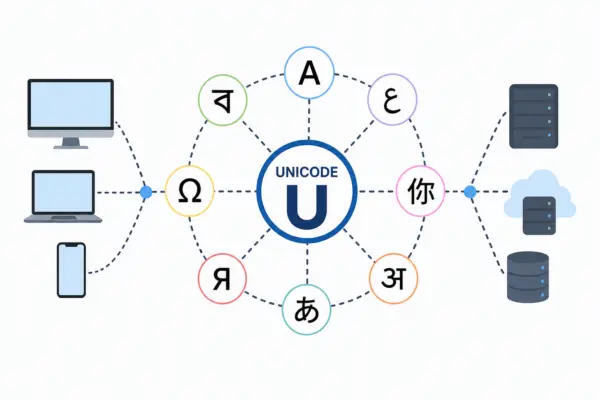
Unicode now covers a huge number of languages — English, Bangla, Arabic, Chinese, Hindi… basically most of the world.
Why did we even need Unicode?
If you go back a few decades, computers were very local in how they handled language. There was a system called ASCII. It could only handle basic English — 128 characters total. That’s it. So every country that used a different language had to create its own system. Bangladesh had Bijoy. Other countries had their own versions, too.
The problem started when people tried to share files between systems. What looked fine on one computer turned into unreadable junk on another. It wasn’t just annoying; it made digital communication messy and unreliable.
So in the late 80s, a group of people decided to fix this properly. They created Unicode so that every language could exist in one system. The first version came out in 1991, and it just kept growing from there.
How it works (without overcomplicating it)
Every character in Unicode gets a number. That number is called a code point. Think of it like giving every letter its own ID card.
For example:
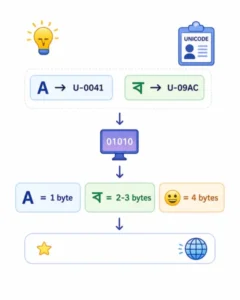
UTF-8 is just a way to store Unicode so computers can use it. It’s actually the most common format on the internet today. What makes it useful is how flexible it is:
UTF-8 in simple terms
But computers don’t actually store letters directly. They store them as bytes. That’s where UTF-8 comes in.
- English letters use very little space
- Bangla, Arabic, and Hindi take a bit more
- Emojis take the most
So instead of forcing everything into one fixed size, it adjusts depending on the character. That’s why websites load fast and still support every language.
The real issue in Bangladesh: Unicode vs Bijoy
Bangladesh has been silently fighting a technological battle for decades. Bijoy versus Unicode. And honestly, the real problem was never about which software is better. It was always about why a whole nation struggled to move forward when the path was clearly visible.
Bijoy earned its place. Back in 1988, it gave people the ability to type in Bangla when that felt like a distant dream. Naturally, offices, newspapers, and schools adopted it. It stopped being just a tool — it became a habit, almost an emotion. But habits can quietly become barriers.
Unicode is the global standard. Every phone, every browser, every modern platform runs on it. While the world moved ahead, Bangladesh held onto Bijoy — and that gap created real consequences. Broken characters, incompatible documents, and a generation stuck relearning what they were already taught wrong.
The root issue was never technical. It was institutional. Schools kept teaching Bijoy because exams demanded it. Offices kept using it because nobody pushed for change. The cycle fed itself, year after year.
Unicode and Non-Latin Scripts
Here’s something most people never stop to think about. When you open WhatsApp and type a message in Urdu, your phone knows exactly what you mean. The letters connect the way they should. The text flows right to left without you having to do anything. It just works — and you probably take that completely for granted. I did too, until I started digging into how any of this actually happens.
The short answer is Unicode. But the longer answer is more interesting, because what Unicode had to solve for languages like Arabic and Urdu wasn’t just a translation problem. It was a fundamentally different way of writing. Different direction, different letter shapes depending on where in a word they appear, tiny marks above and below the letters that change pronunciation entirely. Getting all of that right, on every device, in every app, consistently — that’s genuinely hard.
Unicode dedicated an entire block just to the Arabic script — from U+0600 to U+06FF. That’s not just the alphabet. It includes the harakat, the diacritics, and the special marks that Urdu readers rely on to understand meaning. The people who built this weren’t just checking boxes. They actually had to understand the language well enough to know what couldn’t be left out. And before this existed? Things were a mess, honestly.
If you wanted to write Urdu on a computer twenty years ago, you were probably using InPage or relying on fonts like Nafees. These weren’t bad tools — a lot of people built entire careers and publications with them. But the text they produced had a fundamental flaw: it wasn’t really text. It looked like Urdu, but underneath it was basically an image. You couldn’t select a word and copy it. You couldn’t Ctrl+F to search a document. You couldn’t send someone a file and be confident it would look the same on their machine.
That’s a bigger deal than it sounds. Imagine writing something and not being able to search your own work. Imagine publishing something online that no search engine could ever index. Millions of words, completely invisible to the internet.
Unicode fixed that — not gradually, but completely. The moment Urdu became a proper Unicode script, it became real text. Searchable, copyable, shareable, indexable. A billion-plus people could suddenly participate in the digital world in the language they actually dream in.
A glimpse of Unicode’s diversity
Every letter you’ve ever typed, every symbol you’ve ever copied, every emoji you’ve ever sent — each one has a number. Not a name, not a description, just a number. That’s the core idea behind Unicode. It looks at every writing system humans have ever created, assigns each character its own unique address, and makes sure that address means the same thing everywhere.
That includes the alphabet you’re reading right now. It includes Arabic flowing right to left, Chinese characters built from strokes, ancient Egyptian hieroglyphics, and the crying-laughing face you sent your friend this morning. All of them — one number each, no overlap, no confusion.
Why Unicode is better for the web!
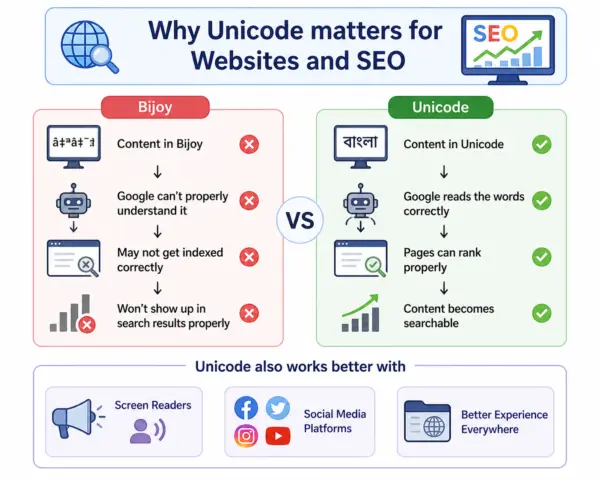
Building a Bangla website requires the right text encoding. Unicode supports most languages, so text displays correctly for visitors regardless of location or device. Search engines read Unicode directly, which helps pages get indexed without encoding errors. Without Unicode, Google may misread Bangla.
Unicode does not depend on specific fonts like SutonnyMJ. On mobile devices, Bijoy fonts display broken symbols when the required font is not installed. This Bangla encoding tool on Android handles this encoding difference without a desktop. The same process works directly in the browser as well.
For developers, Unicode integrates directly with HTML and CSS without encoding errors or corrupted characters. Bangla content built with Bijoy breaks on older phones and unsupported browsers.
Voice typing and Unicode
If you use voice typing today — like Google voice input — you’re already using Unicode without realizing it. When you speak Bangla, it directly converts into Unicode text. No extra step. No conversion. That’s why you can instantly paste it anywhere — messages, websites, documents — and it just works.
(Bangla)
Input
to Unicode text
(Ready to use)
anywhere
Unicode Today — Still Growing
Here’s the thing about Unicode that most people don’t realize — it’s not finished. It never really is. Every single year, the people behind it sit down and ask: What are we missing? What got left out? Whose language isn’t represented yet? The answer keeps changing, and that’s exactly the point.
| 📌Topic | 💡Key Point | 📖Detail / Example |
|---|---|---|
| Evolution Unicode is never finished | Every year, the Consortium asks: what is missing? Whose language is not represented yet? The answer keeps changing — and that is exactly the point. | New scripts and characters are added in every annual release. It is a living, ongoing standard that grows with the world. |
| Programming Default standard in code | Major programming languages treat Unicode as a baseline assumption, not a plugin or option. Developers rely on it without even thinking about it. | Python, JavaScript, Java, and Rust all default to Unicode — so embedded it becomes invisible, which is the highest compliment a standard can receive. |
| Search Google & 100+ languages | Unicode powers multilingual search at a global scale. It is the common thread running beneath every query in every language. | Every search in Tamil, Swahili, or Mongolian on Google is made possible by Unicode — over 100 languages processed every day. |
| Preservation Endangered languages | Linguists and historians collaborate with the Consortium to bring endangered and extinct scripts into the digital world — some with only a handful of speakers left. | Getting a script into Unicode means it survives. It can be typed, searched, taught, and passed on. That is not just technology — that is memory. |
| Governance Who runs Unicode? | The Consortium is a nonprofit led by Apple, Google, and Microsoft — alongside academics, governments, and independent researchers. | It is one of the rare places where a Silicon Valley giant and a scholar of a 2,000-year-old script sit at the same table, working toward the same goal. |
How Bangla Converter Works
Most people do not think about font encoding until the day it ruins something important for them. A journalist finishes a story, copies it into their CMS, and suddenly the entire thing looks like corrupted garbage. A student submits an assignment and the teacher cannot read a single word. A government officer pastes text into an official form and it just breaks.
That moment of confusion is where Bangla Converter comes in. You can use it atour free Bangla converter tool.
Two Systems, Zero Compatibility
Bangladesh has been living with a split for a long time. On one side, you have Bijoy — the encoding system that built its reputation in print media, newspaper offices, and publishing houses over several decades. On the other side, you have Unicode, which is what the entire modern internet runs on. The problem is simple and brutal. These two systems cannot read each other. At all.
Bijoy text on a website looks like nonsense. Unicode text in a Bijoy-based layout program looks just as bad. There is no automatic handshake, no smart detection, no fix built into your operating system. The gap just sits there, and anyone working with Bangla text professionally falls into it constantly.
What the Converter Actually Does
The tool itself is not complicated, and that is the point. You open it, paste your text, and click one button. The conversion happens instantly, and you copy the result. That is the entire workflow.
What makes it genuinely useful is the reliability. It does not just swap characters around. It handles broken words, fixes improperly formatted text, and deals with encoding inconsistencies that pile up when content gets copied and pasted across different platforms. Anyone who has worked with Bangla text seriously knows how messy that can get. A converter that quietly cleans things up while it works saves more time than you would expect.
There is also a built-in typing editor, which means you can write directly in your browser without downloading any keyboard software. For someone who just needs to put together a quick piece of Bangla text and convert it, that alone removes a significant amount of friction.
Why It Still Matters
Unicode won. That is the reality. Every modern platform, every new device, every app built in the last ten years runs on Unicode by default. Bijoy is legacy infrastructure at this point.
But legacy infrastructure does not disappear overnight, especially in places where it is deeply embedded in professional workflows that have been running for thirty years. Bangladesh is still in the middle of that transition. Huge amounts of content exist in Bijoy format. Huge numbers of professionals were trained on Bijoy keyboards and never had a reason to change.
Until everything catches up, the gap between old and new will keep creating problems. And until that gap closes, tools like this one will keep being necessary — not because the technology is impressive, but because the problem is real and the solution is simple.
Four Common Misconceptions About Unicode
A lot of the resistance around switching to Unicode comes down to old information that never got corrected. People heard something years ago, it stuck, and nobody ever sat them down and said — that is not actually true anymore. Here are the four biggest ones worth clearing up.
Unicode makes everything heavier and slower.
Fact
Bijoy only works because your system has a specific font installed. Remove that font and the text becomes unreadable gibberish. Unicode is already baked into every modern OS, every browser, every device. There is no extra weight — the support is already there. If anything, Bijoy is the heavier one.
Bijoy is more accurate for Bangla.
Fact
This comes from habit more than anything else. Bijoy has been around for decades and familiarity feels like reliability. But Unicode was built with real language structure in mind — it covers the full Bangla character set and handles complex letter combinations correctly. Bijoy was a clever workaround for its time. Unicode is what Bangla text was always supposed to look like.
You need special software to type in Unicode.
Fact
This used to have a grain of truth to it — back when typing Unicode Bangla required installing dedicated software and learning a new keyboard layout. That world does not exist anymore. Unicode Bangla is built into Android and iOS by default. Avro makes desktop typing easy. Google Keyboard handles it on mobile without any setup at all.
Only tech-savvy people can switch to Unicode.
Fact
Think about the last time you typed Bangla on your phone — a WhatsApp message, a Facebook comment, anything at all. That was Unicode. You did not install anything, you did not read a manual, you just typed. The idea that Unicode belongs to technical people is one of those things that sounds reasonable until you realize you have already been doing it for years without thinking twice.
Unicode FAQs: Quick Answers
About the Author
Fatima Noor is the founder and editor of BanglaConverterTool.com. She builds free Bangla language tools for journalists, students, and office workers across Bangladesh, with a focus on Unicode and Bijoy encoding.