
The History of Bangla Text Encoding: From Typewriters to Unicode
If you’ve ever pasted a piece of Bangla text into a Word document and watched it turn into a mess of question marks and boxes, you’ve run into a problem that Bengali writers, typesetters, and software developers have been wrestling with for over sixty years. The story of how Bangla went from a language locked to a handful of expensive typewriters to one that renders perfectly on every phone and laptop in the world is not a straight line; it’s a mix of clever hacks, business rivalries, and a global standard that eventually caught up with what Bengali speakers had already built for themselves.
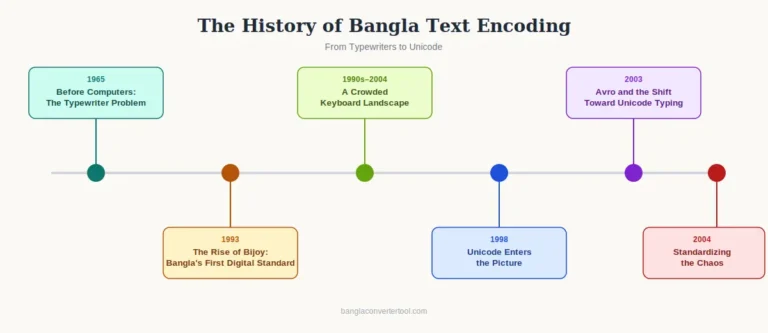
Before Computers: The Typewriter Problem
Long before anyone talked about “encoding,” Bangla had a much simpler problem: mechanical typewriters. English typewriters worked fine with 26 letters, but Bangla has dozens of consonants, vowel signs, and conjunct characters formed by joining two or more letters together. Fitting all of that onto a standard typewriter keyboard was nearly impossible without compromise.
The breakthrough came in 1965, when linguist Munier Choudhury redesigned the Bengali typewriter keyboard in partnership with a typewriter manufacturer then based in East Germany. This layout, known as Munier-Optima, became the dominant way Bengali was typed for decades and later influenced how Bengali was mapped onto computer keyboards once computers arrived.
A few Bengali keyboard layouts appeared even earlier for other machines. Shahidlipi, developed by Saifuddahar Shahid in 1985, was one of the first phonetic-based Bengali keyboards built for early Macintosh computers. It had its moment, but it was quickly overtaken by something far more influential.
The Rise of Bijoy: Bangla’s First Real Digital Standard
In the late 1980s, personal computers started reaching Bangladesh, but there was still no practical way to compose Bengali text digitally for printing and publishing. A journalist-turned-entrepreneur named Mustafa Jabbar saw this gap and built a solution: the Bijoy Bangla keyboard and software. Here’s the clever (and slightly messy) part of how Bijoy worked. Rather than creating a proper Bengali character set, Bijoy took the 128 characters of the ASCII standard — the codes originally meant for English letters and simply replaced them with Bengali glyphs. So a keystroke that would normally produce the English letter “g” would instead display a Bengali character, depending on which Bijoy font was installed. This is why Bijoy is often called a “font substitution” system rather than a true encoding: the underlying data was still plain ASCII, and only the font made it look Bengali.
This approach had a huge practical benefit at the time: it worked on virtually any computer without special software, since it didn’t require the operating system to understand Bengali at all. Bijoy’s Windows version was released in March 1993, and a Macintosh version followed in December 1998. Within a few years, it became the backbone of Bangladesh’s newspaper, magazine, and publishing industry, and Jabbar’s Bijoy layout was later granted legal protection under the Bangladesh Copyright Act of 2005.
The catch was that font-substitution systems are fragile by nature. Text typed in Bijoy only displays correctly if the reader’s device has the exact matching font installed. Move that text to a computer without the font, or paste it into a modern web page, and it turns into gibberish — the same problem people run into today when old Bijoy content meets a Unicode-only website.
A Crowded Keyboard Landscape
Bijoy wasn’t alone for long. Through the 1990s and early 2000s, several competing Bengali keyboard layouts appeared, each solving the same problem in a slightly different way — Bornona (developed in 1993), Bashundhara, Munier, and Lekhoni among them. Each had its own community of users, and because none of them were built on a shared underlying standard, text created in one system often couldn’t be read correctly in another. For anyone working across newsrooms, government offices, or software companies, this fragmentation was a genuine headache: converting Bengali text between systems required knowing exactly which font and layout the original file used.
Unicode Enters the Picture
While Bangladesh was building its own font-based workarounds, a separate, much bigger effort was underway internationally: Unicode. The goal of Unicode was to give every character in every writing system on Earth a unique, permanent numeric code, so that text would display correctly regardless of which software, operating system, or font someone was using.
Bengali script was included in Unicode from very early on, occupying the code block from U+0980 to U+09FF. Unicode’s layout for Bengali characters was deliberately designed to align with the earlier Indian Script Code for Information Interchange (ISCII-1988) standard, which meant conversion between ISCII and Unicode Bengali could happen with minimal data loss. This mattered because it meant Unicode wasn’t a totally foreign system to Indian and Bengali typesetting — it was, in a sense, built on groundwork that already existed.
The real turning point for everyday users came with operating system support. Microsoft Windows added full support for Unicode Bengali starting with Windows 98, which meant that, for the first time, a computer could understand and render Bengali script natively — no special font substitution trickery required. Adobe’s design software took considerably longer to catch up, which is part of why Bijoy-style fonts stuck around in the print and design industry long after Unicode became the standard for the web.
Avro and the Shift Toward Unicode Typing
Government and operating-system support for Unicode Bengali was one thing; giving ordinary people an easy way to type in it was another. That gap was closed in 2003, when Omicron Lab released Avro, a free and open-source Bangla typing tool. Avro’s biggest innovation was its phonetic keyboard, which let people type Bengali words by spelling them out using Roman/English letters; the software would automatically convert what you typed into proper Bengali Unicode characters as you went.
Avro also included a “Unibijoy” keyboard option, essentially replicating the familiar Bijoy key layout but outputting genuine Unicode text instead of font-substituted ASCII. This made the transition much easier for people who had spent years training their fingers on the Bijoy layout; they could keep their muscle memory while finally producing text that worked everywhere, from websites to smartphones to modern word processors.
Standardizing the Chaos: The National Keyboard Effort
By 2004, the number of competing Bengali keyboard layouts — Bijoy, Bashundhara, Munier, Borno, Lekhoni, and others — had become enough of a problem that an initiative was launched to develop a single national Bangla computer keyboard standard. Out of related standardization efforts came UniJoy, a Unicode-optimized layout closely modeled on the familiar Bijoy key positions but standardized for Unicode by the Ekushey project. The intent was straightforward: give people a keyboard layout that felt familiar, but that produced text built on the global Unicode standard rather than a proprietary font hack.
Where That History Leaves Us Today
This back-and-forth between legacy font-based systems and modern Unicode is exactly why converter tools exist. Decades of Bijoy content — newspaper archives, government documents, old publishing files — were created using font substitution, and that content doesn’t just “become” Unicode on its own. It has to be converted, character by character, from the old ANSI-based Bijoy mapping into proper Unicode code points, and vice versa when Unicode text needs to be prepared for older Bijoy-based printing and layout software still used across parts of Bangladesh’s publishing industry.
Understanding this history also explains a few things that otherwise seem confusing: why Bijoy files look broken on modern browsers, why newspapers and government offices still ask for Bijoy-formatted submissions, and why phonetic typing tools like Avro became so popular so quickly. It isn’t a story about one system beating another — it’s a story about a language finding several different ways to survive the transition from typewriters to the internet, with each generation of tools building on lessons learned from the last.
